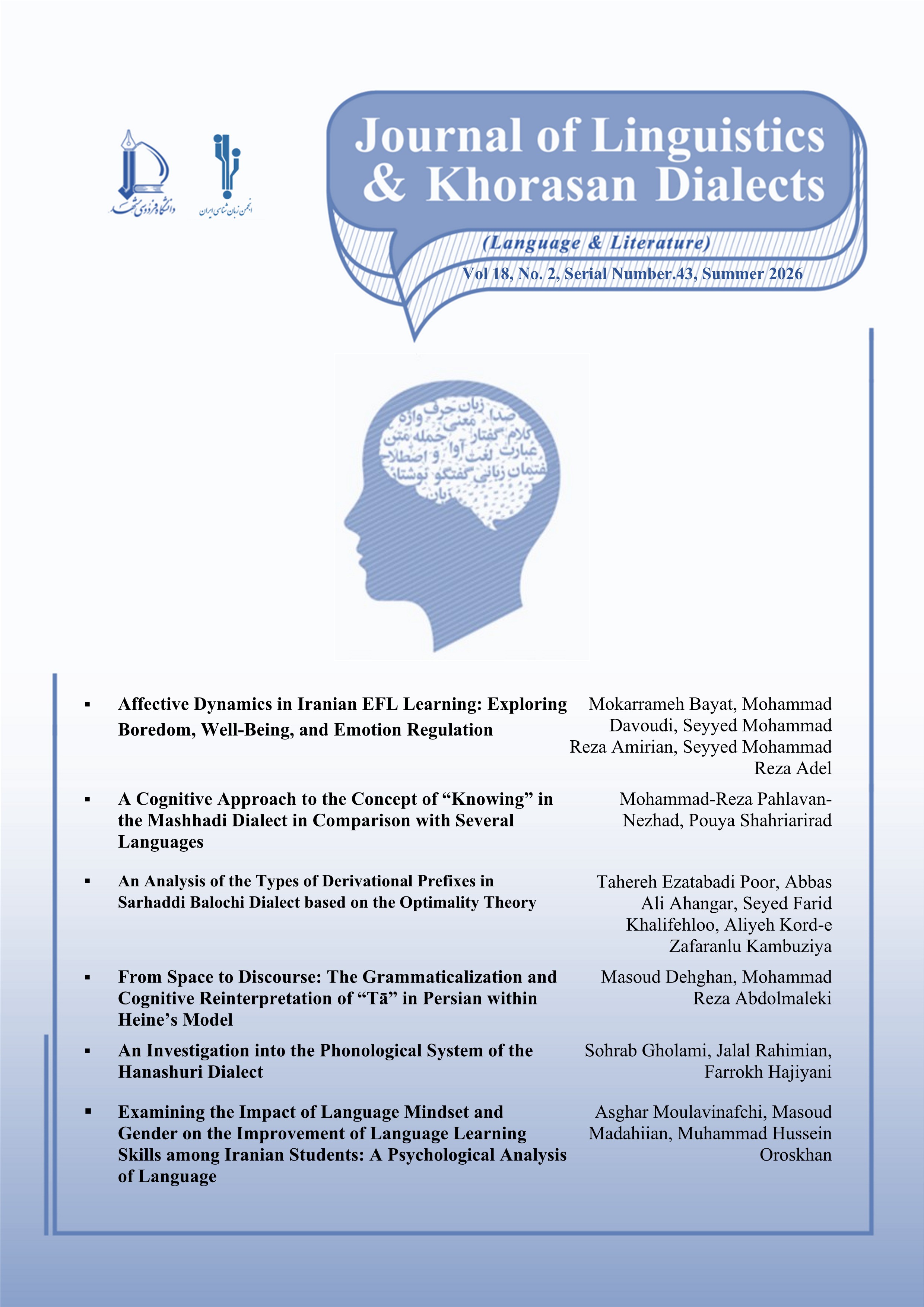
Journal of Linguistics and Khorasan Dialects

Journal of Linguistics and Khorasan Dialects

See more informatiom in Journal Metrics

 Publication start year
2011
 Number of Volumes 18
 Number of Issues 43
 Number of Authors 512 
 Number of submissions 991
 Number of Reject Articles 399
 Number of Accept Articles 329
 Number of Reviewers 241

The Journal of Linguistics and Khorasan Dialects  is a peer-reviewed academic journal specializing in linguistics, committed to publishing original and high-quality research articles across all major and interdisciplinary branches of the field. Given the journal’s geographical and cultural context, special emphasis is placed on studies related to the dialects and linguistic varieties of the Khorasan region. Such contributions are given priority in the publication process. By adhering to rigorous academic standards and a thorough peer-review process, this journal aims to provide a platform for innovative research that contributes to the broader development of linguistic knowledge—particularly in the context of Iranian linguistics. Authors may submit their articles to the journal in either Persian or English.


Current Issue: Volume 18, Issue 2 - Serial Number 43, Summer 2026, Pages 1-220 

Affective Dynamics in Iranian EFL Learning: Exploring Boredom, Well-Being, and Emotion Regulation

Pages 1-31

10.22067/jlkd.2025.95612.1347

Mokarrameh Bayat, Mohammad Davoudi, Seyyed Mohammad Reza Amirian, Seyyed Mohammad Reza Adel

An Analysis of the Types of Derivational Prefixes in Sarhaddi Balochi Dialect based on the Optimality Theory

Pages 59-98

10.22067/jlkd.2026.97419.1366

Tahereh Ezatabadi Poor, Abbas Ali Ahangar, Seyyed Farid Khalifehloo,, Aliyeh Kord-e Zafaranlu Kambuziya

Keywords Cloud

  • Persian
  • critical discourse analysis
  • Persian language
  • cognitive linguistics
  • gender
  • cognitive semantics
  • metaphor
  • Ideology
  • conceptual metaphor
  • optimality theory
  • sociolinguistics
  • Bilingualism
  • Typology
  • Discourse analysis
  • Kurdish Language
  • Middle persian
  • Distributed Morphology
  • Mashhadi dialect
  • Semiotics
  • narrative
  • Polysemy
  • Role and Reference Grammar
  • Fairclough
  • syllable
  • discourse
  • Iranian languages
  • Etymology
  • Age
  • grammaticalization
  • Standard Persian
  • Syntax
  • morphology
  • Grammatical metaphor
  • theme
  • Kalhori Kurdish
  • Education
  • phonological processes
  • animacy
  • Pragmatics
  • Metonymy
  • definiteness
  • shamloo
  • image schema
  • lexical aspect
  • acoustic phonetics
  • conceptual metaphors
  • Mazandarani
  • Dialect
  • ellipsis
  • cultural linguistics
  • sentence
  • Literary creativity
  • Aspect
  • dissociation
  • compound verbs
  • Fear
  • Coherence
  • Causee NP
  • Present perfect
  • prototype theory
  • Iranian languages and dialects
  • Linguistics and translation studies
  • Covid-19
  • Reading skill
  • Teaching
  • cognitive approach
  • tense
  • Conversation Analysis
  • Nezami
  • vowel harmony
  • Persian dialectology
  • Systemic functional grammar
  • semantic network
  • complementizer
  • Minimalist Program
  • Mazinani Dialect
  • distributed model
  • Media
  • telicity
  • Causative constructions
  • documentation
  • Language
  • localist model
  • conceptualization
  • Nimayoshij
  • extended projection principle
  • generative phonology
  • Ferdowsi University of Mashhad
  • Phase Theory
  • Iranian dialectology
  • euphemism
  • relative pronoun
  • fusion
  • Motor Transcortical Aphasia
  • Iconicity
  • idioms
  • Personality
  • historical linguistics
  • Old Persian
  • Halliday
  • Broca aphasia
  • Conceptual blending
  • \"
  • Iranian studies
  • information structure
  • gapping
  • dialectology
  • English
  • Iranian Dialects
  • Hanashuri Dialect
  • Ideology and power
  • Esfidani Turkish
  • PRO
  • Phonological Process
  • sex
  • cohesion
  • Lexical Typology
  • Animacy hierarchy
  • discourse markers
  • Spiritual cultural heritages
  • Novel
  • collocation
  • Syllable Contact Law
  • Symmetric Merge
  • corpus linguistics
  • archetype
  • ergative
  • Hedges
  • endangered languages
  • Cultural semiotics
  • interpersonal metafunction
  • narrative structure
  • Legitimacy
  • Causer NP
  • Phonology
  • Critical analysis of mystical discourse
  • Agreement
  • Cognitive Sociolinguistics
  • Speech act
  • Corpus
  • c-command
  • Universal
  • Neurofeedback
  • humanistic
  • grammatical errors
  • relative tense
  • resumptive pronoun Persian
  • Culture dimensions
  • Phonological priming
  • Molana’s letters
  • emotional dynamics
  • Mental lexicon
  • phrasal compound
  • bilinguals
  • thematic roles
  • Spreading activation
  • Mood metaphor
  • creative beauty
  • Object complement
  • Morph Movement
  • Arabic language
  • National Anthem
  • Justice
  • Birjandi Dialect
  • grammatical weight
  • topicalization
  • Cappelen and Lepore
  • Complement
  • Vowel raising
  • Artificial Intelligence
  • forensic phonetics
  • Underlying Ideologies
  • Genre Analysis
  • Mountain leopards
  • Viewing angle
  • Control
  • study of Hobbit
  • Advantages
  • illustration
  • Toulmin
  • processes involved in reading
  • structural approach
  • Syntactic Features
  • Epenthesis
  • 9/11 event
  • Yeki Boud Yeki Naboud
  • Ansi Al-Haj
  • non-deliberate metaphor
  • split-C system
  • Persian language child
  • speaker-specific information
  • Senses
  • covert syntax
  • Souvashoon
  • Valence
  • ideational metafunction
  • Semio-semantics
  • Government
  • Moving-Ego
  • Functional properties of subject

Related Journals