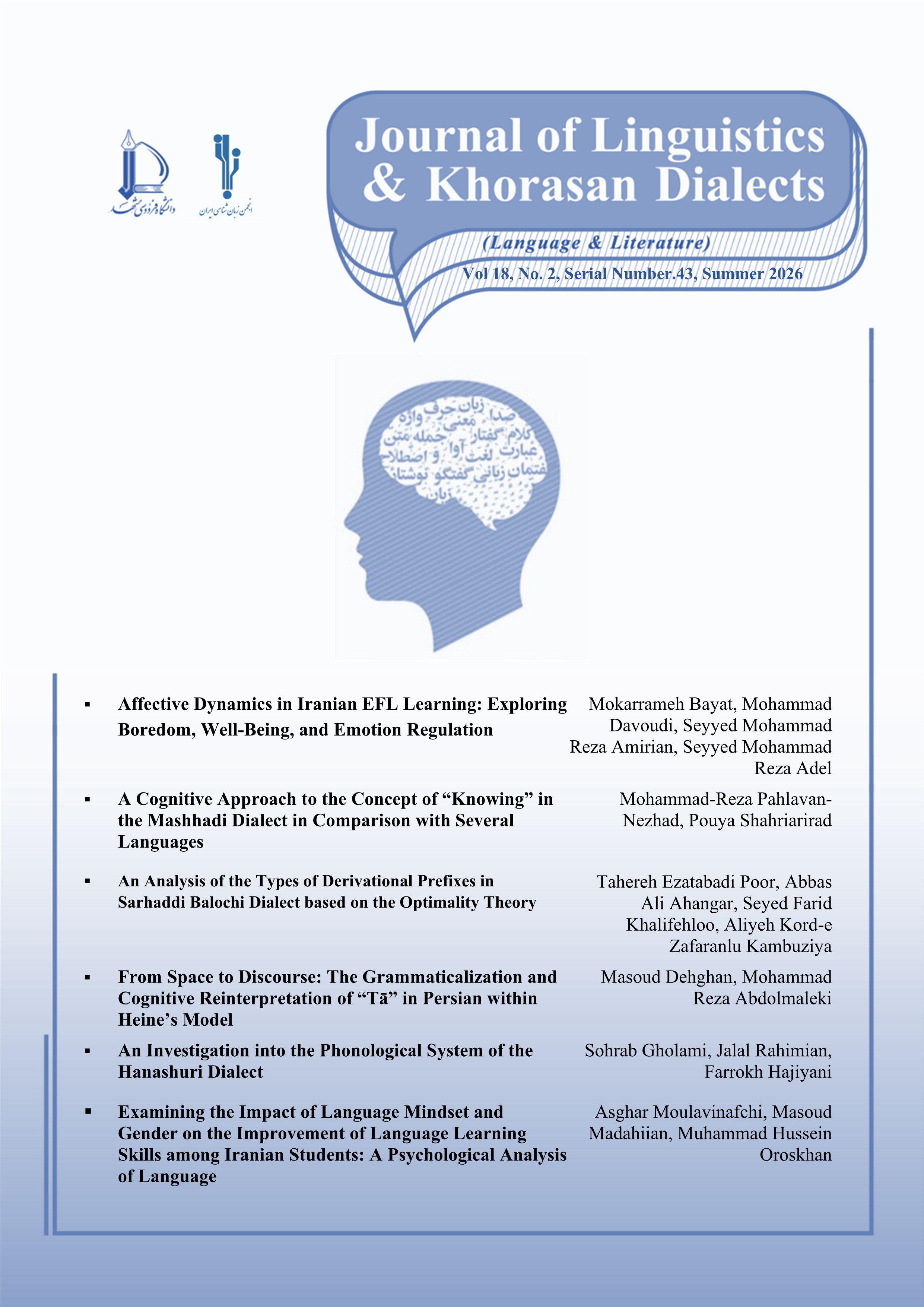
Journal of Linguistics and Khorasan Dialects

Journal of Linguistics and Khorasan Dialects

See more informatiom in Journal Metrics

 Publication start year
2011
 Number of Volumes 18
 Number of Issues 43
 Number of Authors 508 
 Number of submissions 979
 Number of Reject Articles 397
 Number of Accept Articles 327
 Number of Reviewers 241

The Journal of Linguistics and Khorasan Dialects  is a peer-reviewed academic journal specializing in linguistics, committed to publishing original and high-quality research articles across all major and interdisciplinary branches of the field. Given the journal’s geographical and cultural context, special emphasis is placed on studies related to the dialects and linguistic varieties of the Khorasan region. Such contributions are given priority in the publication process. By adhering to rigorous academic standards and a thorough peer-review process, this journal aims to provide a platform for innovative research that contributes to the broader development of linguistic knowledge—particularly in the context of Iranian linguistics.

Current Issue: Volume 18, Issue 2 - Serial Number 43, Summer 2026, Pages 1-220 

Affective Dynamics in Iranian EFL Learning: Exploring Boredom, Well-Being, and Emotion Regulation

Pages 1-31

10.22067/jlkd.2025.95612.1347

Mokarrameh Bayat, Mohammad Davoudi, Seyyed Mohammad Reza Amirian, Seyyed Mohammad Reza Adel

An Analysis of the Types of Derivational Prefixes in Sarhaddi Balochi Dialect based on the Optimality Theory

Pages 59-98

10.22067/jlkd.2026.97419.1366

Tahereh Ezatabadi Poor, Abbas Ali Ahangar, Seyyed Farid Khalifehloo,, Aliyeh Kord-e Zafaranlu Kambuziya

Keywords Cloud

  • critical discourse analysis
  • Persian
  • Persian language
  • cognitive linguistics
  • cognitive semantics
  • gender
  • Ideology
  • metaphor
  • conceptual metaphor
  • Bilingualism
  • sociolinguistics
  • optimality theory
  • Typology
  • Discourse analysis
  • Mashhadi dialect
  • Kurdish Language
  • Distributed Morphology
  • Middle persian
  • syllable
  • Role and Reference Grammar
  • discourse
  • Age
  • Etymology
  • Fairclough
  • narrative
  • Semiotics
  • Polysemy
  • Iranian languages
  • Dialect
  • Pragmatics
  • theme
  • Syntax
  • definiteness
  • conceptual metaphors
  • acoustic phonetics
  • ellipsis
  • Kalhori Kurdish
  • morphology
  • Grammatical metaphor
  • shamloo
  • Mazandarani
  • phonological processes
  • Metonymy
  • Standard Persian
  • animacy
  • lexical aspect
  • image schema
  • Education
  • grammaticalization
  • Causative constructions
  • archetype
  • Ferdowsi University of Mashhad
  • Linguistics and translation studies
  • Minimalist Program
  • sentence
  • Phonological Process
  • tense
  • Cultural semiotics
  • discourse markers
  • Novel
  • ergative
  • sex
  • endangered languages
  • localist model
  • Language
  • Esfidani Turkish
  • Media
  • Legitimacy
  • \"
  • interpersonal metafunction
  • conceptualization
  • Iranian studies
  • Nimayoshij
  • Iranian languages and dialects
  • Hanashuri Dialect
  • prototype theory
  • complementizer
  • compound verbs
  • Hedges
  • Corpus
  • fusion
  • Agreement
  • Spiritual cultural heritages
  • Cognitive Sociolinguistics
  • generative phonology
  • Iranian Dialects
  • documentation
  • Literary creativity
  • Phonology
  • Critical analysis of mystical discourse
  • Ideology and power
  • Lexical Typology
  • Persian dialectology
  • relative pronoun
  • Covid-19
  • Symmetric Merge
  • Teaching
  • Conceptual blending
  • Conversation Analysis
  • Broca aphasia
  • Motor Transcortical Aphasia
  • distributed model
  • Mazinani Dialect
  • dissociation
  • Nezami
  • Phase Theory
  • Personality
  • Systemic functional grammar
  • Fear
  • gapping
  • idioms
  • Iranian dialectology
  • Speech act
  • Aspect
  • Halliday
  • Reading skill
  • historical linguistics
  • Iconicity
  • cohesion
  • Animacy hierarchy
  • Causee NP
  • English
  • dialectology
  • Coherence
  • Present perfect
  • Causer NP
  • semantic network
  • cognitive approach
  • information structure
  • telicity
  • Syllable Contact Law
  • vowel harmony
  • extended projection principle
  • euphemism
  • corpus linguistics
  • Old Persian
  • PRO
  • narrative structure
  • collocation
  • cultural linguistics
  • Women
  • : infinitive clause
  • phatic
  • idiom
  • Emotions
  • proverb
  • Marginalization
  • formulaic speech
  • analysis
  • Happiness
  • Nodal point
  • spectrogram
  • third formant
  • second formant
  • first formant
  • Waqf
  • duration
  • intensity
  • pain
  • intertextuality
  • vowel-to-consonant assimilation
  • pleasure
  • Delphi Method
  • Creativity
  • subjunctive
  • Children
  • finiteness
  • Racism
  • Control
  • Minimalist syntax
  • Modernization
  • psychological well-being
  • Phenomenology
  • deconstruction
  • RFC model
  • Time management
  • Complement
  • Interrogative pronoun
  • Stress
  • Doctor-Patient talk
  • c-command
  • Power/ Solidarity relations
  • Reading
  • Scientometrics
  • Bread
  • Content analysis
  • scope
  • logical form
  • advertisements
  • equivalence
  • Medical ethics
  • covert syntax
  • Ezafe Construction
  • Maximal Projection
  • Minimal Projection
  • Modifier
  • perception
  • Emotion
  • gender identity
  • war literature

Related Journals